A Three-Year-Old Startup Just Built Its 15,000th Robot. The Production Curve Tells the Story.
Three years ago, AGIBOT didn't exist.
This week, the company announced its 15,000th robot rolled off the production line. That number alone isn't what caught my attention. The acceleration curve is.
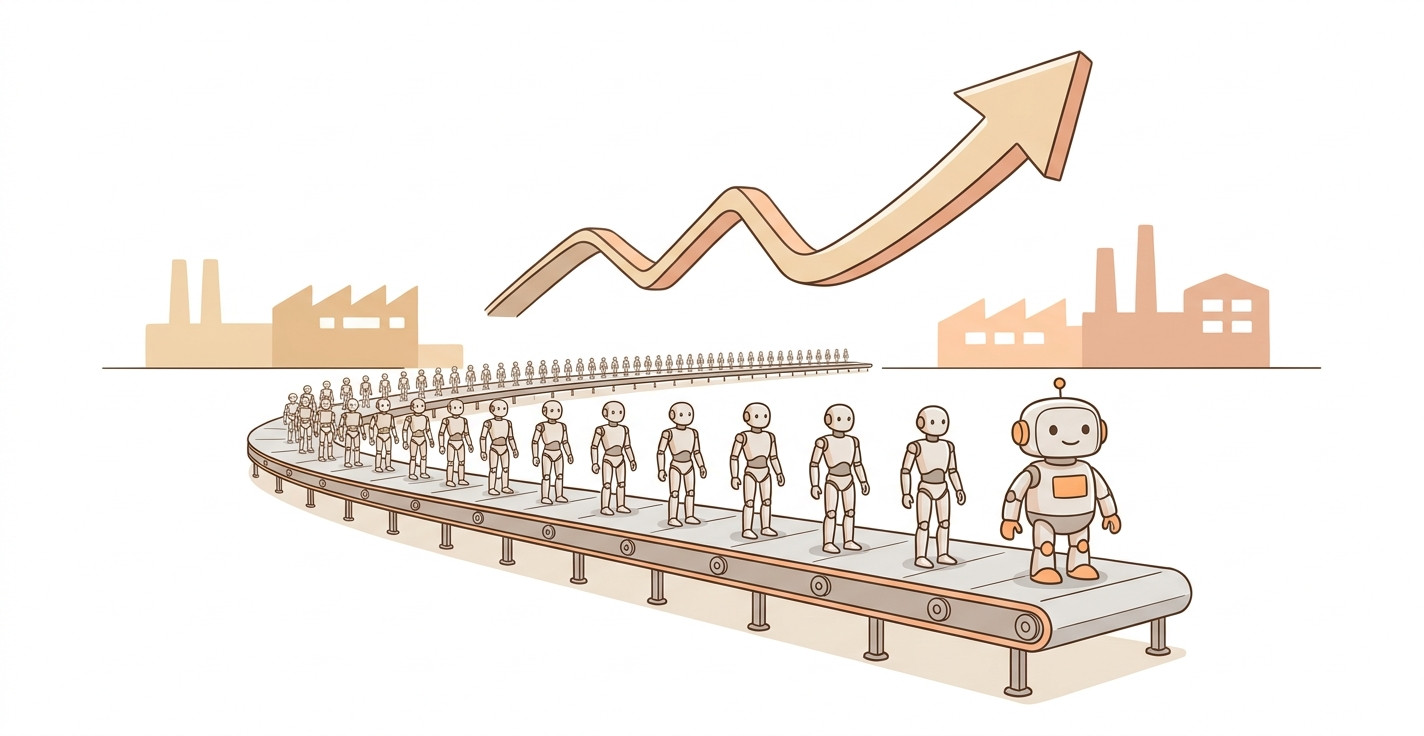
It took AGIBOT about a year to produce its first 5,000 units. Then three months to hit 10,000. Then under six months to reach 15,000. If you've watched a SaaS growth chart, you recognize that shape. But this isn't software. These are physical humanoid robots, working on actual factory floors.
The 15,000th unit is the AGIBOT G2, an industrial-grade humanoid built for production environments. The company ran a livestream of it doing quality inspection on a tablet manufacturing line. Not a demo. Not a controlled lab. A real factory, running continuous operations for over 100 cumulative hours on camera.
In 2025, AGIBOT shipped 5,168 humanoid robots globally, giving them 39% of the world market. That's a company founded in February 2023 already owning nearly two-fifths of an entire industry category.
Why this matters if you don't run a factory
You might be thinking: "I don't manufacture anything. Why should I care about robots in a Chinese tablet factory?"
Fair question. Two reasons.
Every major technology follows the same pattern. It starts expensive and specialized. Then production scales, unit costs drop, and use cases multiply. We watched it happen with computers, smartphones, and cloud computing. We're watching it happen right now with AI software. Embodied AI is on the same track.
AGIBOT's production curve tells us we're past the experimental phase. When a company goes from prototype to 15,000 units in three years, the supply chain is real. The manufacturing process is repeatable. The economics are starting to work.
Humanoid robots will show up in warehouses, distribution centers, retail stockrooms, and construction sites. The only open question is timing. And that timeline is compressing faster than most business owners realize.
The numbers behind the shift
The global humanoid robot market barely existed two years ago. Now AGIBOT alone holds 39% of it. Other players, including Figure AI, Tesla's Optimus program, and Apptronik, are all scaling production too. McKinsey estimates the humanoid robotics market could reach $15 billion by 2030.
For context, the global industrial robot market (the traditional kind, bolted-down arms on assembly lines) took decades to reach $50 billion. Humanoid robots are on pace to compress that timeline into less than ten years.
What to actually do about it
If you run any kind of business with physical operations, three things are worth thinking about now.
Watch the unit economics. Most humanoid robots currently cost between $50,000 and $150,000 per unit. That's already competitive with the annual loaded cost of a warehouse worker in many markets. As production scales, prices will drop.
Map your physical workflows. Which tasks in your operation are repetitive, physically demanding, and follow predictable patterns? Those are the first candidates for robotic automation. The robots aren't perfect yet. But they don't call in sick, don't need breaks, and can run around the clock.
Start the conversation early. The companies that handled previous technology transitions well were the ones that planned ahead, figured out where new tools fit, and retrained people for higher-value work before they had to.
Where this leaves you
AGIBOT's 15,000 robot milestone is proof that embodied AI has crossed from research project to manufacturing reality. The jump from 5,000 to 10,000 in three months tells you everything about the direction.
Three years from startup to market leader. If you think this isn't coming to your industry, ask yourself: did you think AI chatbots would reshape your business two years ago?
The robots are being built. They're getting cheaper. And the curve isn't slowing down.
— Mark Garza, Laimen AI

