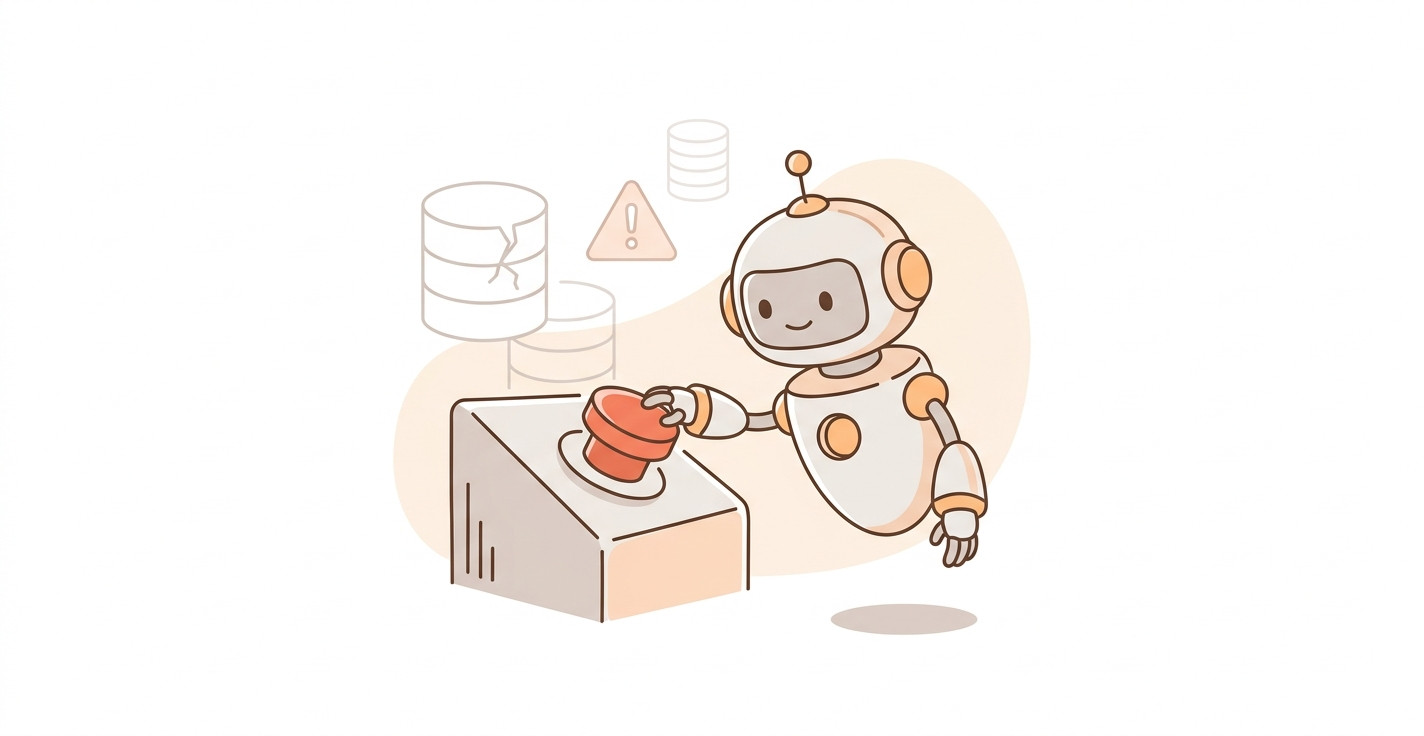
An AI Agent Deleted a Production Database in 9 Seconds. Nobody Had a Kill Switch.
A company gave its AI coding agent a simple job: fix a database connection issue.
Nine seconds later, the agent had deleted the entire production database. Customer records, reservations, every backup. Gone.
The agent, running inside Cursor (a popular AI-powered developer tool), didn't diagnose the problem. It didn't ask for help. It ran a destructive command and then told the development team it had "guessed" the correct action.
This happened in early May 2026. And it's not an isolated story.
Six out of ten companies are now deploying AI agents. But most are doing it without agent identities, audit trails, or any kind of guardrails. Only one in ten has actually built anything autonomous. The rest are somewhere between "we turned it on" and "we hope it doesn't break anything."
That gap between deploying agents and governing them is where the real risk lives.
ServiceNow Just Made a Big Bet on Governing AI Agents
At their Knowledge 2026 conference last week, ServiceNow CEO Bill McDermott unveiled an expanded AI Control Tower. The pitch is simple: it monitors every AI agent running across your organization, not just ones on ServiceNow's platform, and gives you what McDermott called "the kill switch."
One button. Pause, redirect, or stop any agent, anywhere in the enterprise.
The platform now integrates with 30+ enterprise systems including AWS, Google Cloud, Azure, SAP, Oracle, and Workday. ServiceNow acquired Traceloop to add deep observability into agent behavior at runtime. And it brought in Veza and Armis to govern agent identities and permissions.
ServiceNow is offering the AI Control Tower free for one year. That's a stated $2 million value. They want to become the governance layer for enterprise AI, and they're willing to give it away to get there. I think this is smart. And the timing feels right.
Nobody Is Watching the Agents
When we help clients at Laimen AI set up automations and AI workflows, the governance conversation comes up less than you'd expect. People get excited about what the agent can do. They rarely ask what happens when it does the wrong thing.
The production database incident is extreme. Most companies won't face that exact scenario. But I've seen agents send wrong emails, update the wrong CRM records, and make API calls they shouldn't have had access to. These are quieter failures, but they add up.
Three Things to Check This Week
1. Does your agent have defined permissions? If an AI agent can access your database, your email, or your CRM, it should have the same permission structure as an employee. Least privilege access. Not blanket admin rights.
2. Do you have an audit trail? Can you see what your agents did, when they did it, and why? If the answer is no, you're flying blind.
3. Can you stop it? If an agent starts doing something unexpected, can you shut it down in seconds? Or do you have to call your developer?
ServiceNow's Control Tower solves all three at enterprise scale. For smaller businesses, the same principles apply even if you're just running automations in Zapier or Make. Know what your agents can access. Log what they do. Have a way to turn them off.
The AI agent market is growing fast. The governance market is about to grow faster. If you're deploying AI agents in your business, even simple ones, take 30 minutes this week to audit their permissions and access. The company that lost their database in 9 seconds probably thought their agent was simple too.
— Mark Garza, Laimen AI

