Most Companies Are Losing the AI Race and Don't Know It Yet
A friend of mine runs a mid-size logistics company in Dallas. Last month he told me he'd "done AI" because his team started using ChatGPT to write emails. He seemed proud of it. I didn't have the heart to tell him he was already falling behind.
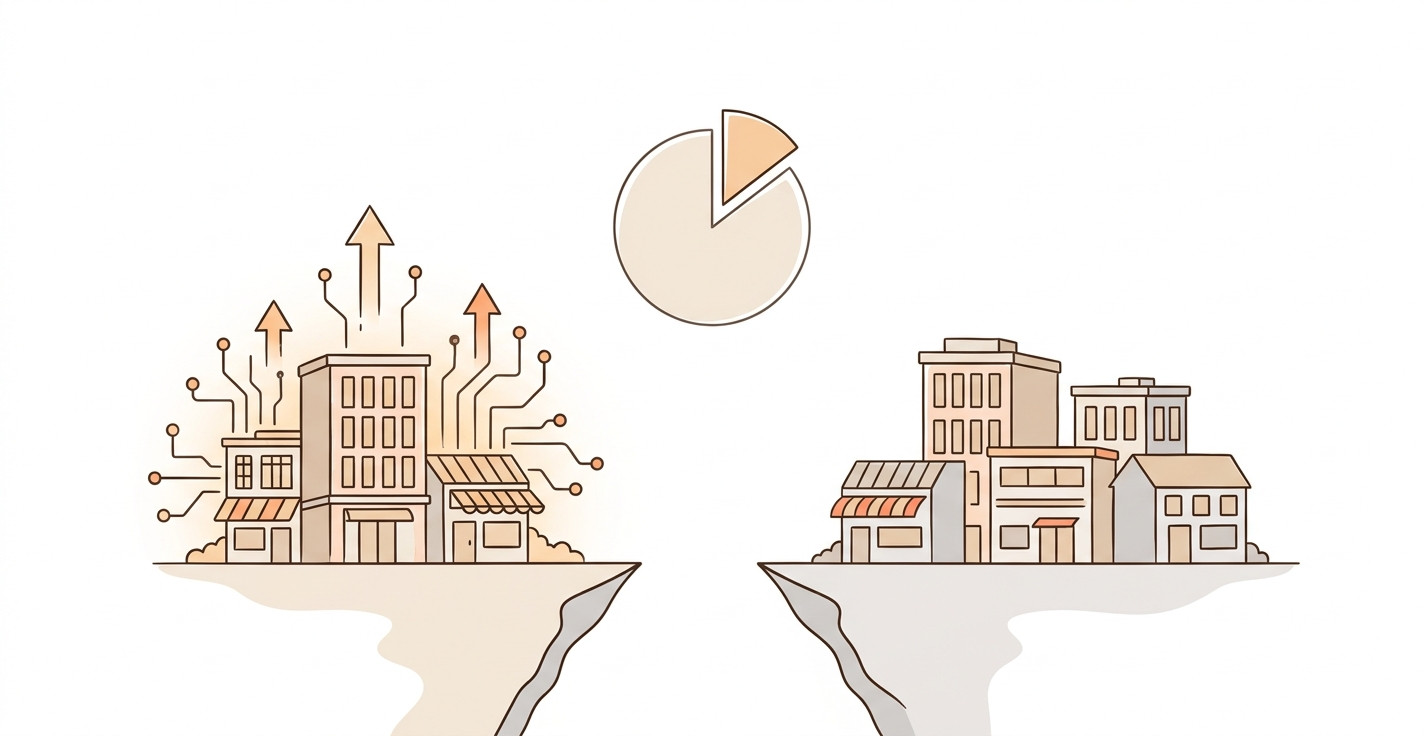
PwC just published its 2026 AI Performance Study, and the numbers back up what I've been seeing on the ground. They surveyed 1,217 senior executives across 25 sectors. The headline finding: 20% of companies are capturing 74% of AI's total economic value. Everyone else is splitting the leftovers.
The gap is bigger than you think
The top performers in PwC's study generate 7.2 times more value from AI than their competitors. Their profit margins run four percentage points higher. And they're pulling further ahead, not leveling off.
That 7.2x number stopped me cold. We're not talking about a slight edge. We're talking about companies in the same industry, same size bracket, and one group is getting seven times the return on similar investments.
What the winners do differently
The study makes one thing clear. Leaders don't treat AI as a cost-cutting tool. They treat it as a growth engine.
Specifically, top performers are 2.6 times more likely to say AI helps them reinvent their business model. They're two to three times more likely to use AI to spot growth opportunities where industries overlap. They look at AI and ask "what new things can we sell?" instead of "where can we trim headcount?"
They also let AI do more. Leaders are 1.8 times more likely to run AI systems that handle multiple tasks inside defined guardrails. They're 1.9 times more likely to let AI operate in self-optimizing modes, where the system adjusts its own approach based on results.
My logistics friend? He's using AI to write slightly better emails. The leaders in his industry are using it to reroute shipments in real time, predict demand shifts, and find entirely new revenue streams.
Why most companies get stuck
I've consulted with about two dozen businesses on AI adoption over the past year. The pattern is almost always the same. A company buys a tool, assigns it to one department, gets a modest win, and then stops there. They call it a success and move on.
That's the trap. The modest win feels good enough. But while you're celebrating a 10% efficiency bump in one department, the company down the street is rebuilding their entire customer acquisition pipeline around AI. They're not just faster. They're playing a different game.
PwC's data confirms this. The laggards focus on productivity. The leaders focus on reinvention. Both use AI, but for completely different purposes.
What to do about it this week
If you run a small or mid-size business, here's where I'd start. Pick your highest-revenue process, not your most annoying one. Map every step. Then ask: where could AI make a decision, not just assist a human?
That shift from "AI as assistant" to "AI as decision-maker within guardrails" is exactly what separates the 20% from the 80% in this study. You don't need a massive budget. You need a different question.
The window to catch up is still open, but it's closing faster than most people realize. When 20% of companies hold 74% of the value, the math gets ugly for everyone else pretty quickly.
— Mark Garza, Laimen AI

